Why should the local church be important to us? from Randy Alcorn on Vimeo.


The Up the Middle Church
 Matt Keller won my heart right away in his book, The Up the Middle Church, and he kept my heart and mind engaged all the way through. He writes,
We love to hear the stories of churches that start in faith, and within a few short months are living the long bomb....thousands in weekend attendance....We dream of what it would be like to be a part of something God visits that way....Matt is a highly successful pastor (as most tend to measure success) and his Next Level Church in Fort Myers, Florida, is a highly effective church. But he shares openly and vulnerably from his experience of falling in the trap most church planters and church leaders succumb to of wanting to be a "long-bomb" success story...when they would do better to follow an up-the-middle strategy.
But their story is not my story.
Boy, could I identify with Keller and his story. And most of what he said resonated with me. I highlighted broad swaths of the book. Some of those:
Up-the-middle churches design effective programs that serve their "most likely to attend" audience. Too many churches design programming based off past church experiences, not present-day realities. "We always had that..." or, "We did it that way in my last church," statements that have no place in an up-the-middle reality.Keller and his church are not where I am. But they've been where I am. And by God's grace, I pray they are where we are going.
We are committed to being for every church in our city. We filter all of our communication with the community through the lens of one question: "Could any of our language be construed in any way as competitive or negative toward another church?" If the answer is yes in any way, then we rework it completely."
Protecting the culture of your church requires having some hard conversations....As a new or small church, you inevitably have some well-meaning Christians who begin attending but have a preconceived idea of what they think church should look like....You'll feel the temptation to bend or compromise your culture in order to appease or keep those people....However, protecting the culture you feel led by God to create is your responsibility.
Because of pressure or desperation, too many pastors compromise the culture of their church in order to accommodate an individual or small group of people.
One of the biggest keys to self-care is being okay with getting away.
At the end of the day, it's not about how many people were in the seats, or how big the offering was; it's about the lives that were changed. In redefining success, this one must hit us the hardest....Never underestimate the lives that are being changed every week.
If you are in ministry--whether as a church planter, a pastor, elder, ministry leader, or in some other role--I highly, highly recommend The Up the Middle Church. And if you're starting a church (or have started one), consider it required reading.
The Greatest Miracle in Acts
 All these years as a Bible student, teacher, preacher, writer, and pastor, and something big just occurred to me in the last few days. You know what I think the biggest miracle in the whole book of Acts was? Perhaps the greatest miracle in the Bible? Maybe in all of church history?
Not the tongues of fire or the gift of tongues (Acts 2:3-4). Not the healing of the crippled man at the Beautiful Gate (Acts 3:1-8). Not the healing of Aeneas (Acts 9:33-34) or even the raising of Dorcas (Acts 9:36-41).
I think the greatest miracle is one that apparently happened over and over in the early days of the church. It's recorded in Acts 1:14. And again in Acts 2:1. And Acts 2:46. And Acts 4:24, and 5:12. The miracle is described in Acts 2:1 in just nine words:
"They were all with one accord in one place."The early church is repeatedly described as being "in one accord."
I wonder if that's the miracle that engendered all the other miracles. I wonder if the Holy Spirit worked so mightily in those first days of the church BECAUSE of the church being in one accord. I wonder if THAT miracle made all the OTHER miracles possible, even commonplace. They weren't arguing about worship styles or hair styles. They weren't judging each other or jealous of each other. They weren't petty, piqued, or peeved with each other. "They were all with one accord in one place."
Wow.
That is a miracle.
It's one I've never really recognized before as a miracle. But it deserves to be recognized. And repeated.
I don't know if I've ever experienced that "in one accord"-ness. Maybe in the earliest days of my church, Cobblestone. And, indeed, I think that "in one accord"-ness resulted in miracles. But, as will happen when human nature wins out over God's nature, we've lost that. But I pray with my whole heart: God, please do it again.
Church of the Week: Asbury College Auditorium
 In the years prior to my brother Larry's 1977 graduation from Asbury College (now Asbury University), I had occasion several times to visit him there and attend chapel services (held every Monday, Wednesday, and Friday at 10 a.m.) in Hughes Auditorium (dedicated in 1929).
 It is a beautiful auditorium in the best traditions of Methodism:dark wood paneling, cream-colored plaster walls with a balcony on three sides, lovely stained glass windows, a fine pipe organ. As I recall, the acoustics are wonderful, and many of the finest preachers in history have spoken here. Hughes Auditorium was also the site of the student revival that began on February 3, 1970 and lasted for 144 uninterrupted hours.
Sunday Night Rejoicings
 "The only thing that matters," wrote Paul in Galatians 5:6, "is faith expressing itself in love."
This weekend, at least, God's people at Cobblestone Community Church have shown themselves to be "1Thing Matters" kinda people. And, just in case I haven't mentioned it before, I love my church. I rejoice in my church. I am committed to my church. Let me tell you why.
Yesterday (Saturday) began bright and early with the InMotion Children's Ministry Fall Workshop. Children's Director Shena Ashcraft planned and pulled off a great day of fellowship and training for children's ministry volunteers. One of the sessions was Pastor Tim Tice of GracePointe Community Church in Oxford (below) teaching on How to Lead a Child to Christ. The workshop also provided an introduction to the new OverDrive format for the Fall, which I am excited to see! Thank you so much to Shena and all the volunteers who attended and pitched in for this event!
 While the InMotion Workshop was going on, a group of us left The Loft for our monthly Second Saturday outreach. We headed to the two Farmers' Markets in Oxford to hand out free bottled water to the vendors and the customers. While it started in the rain (below), by the time we made it to the uptown market, the rain had disappeared and we were blessed to give away the rest of the waters (about 100 total) while enjoying beautiful September weather. Thank you so much to all the volunteers who reached out in love to our community.
 By the time we made it back to The Loft, Cobblestone Women's Connection's Coupon Swap was getting underway. Guest speaker Charlotte Wood offered financial counsel while the participants snipped and swapped coupons (below). We also had a blast blessing the women in attendance with donated items we had received from Hallmark; it was like Christmas morning in September!
 I was also so blessed by our volunteers Angie Abner and Debbie Stumph, who put in much time and effort Saturday afternoon cleaning the Loft with loving care! Thank you both for your work!
And then it was Sunday. The Lord's Day. Oh my. Thank you, Gary Antonius and outreach committee for brainstorming "G56 Day," and thank you Cobblestone Leadership Team for approving their plan to "close the church" and send the Church out into the community to express their faith in love. What a day this was!
 It started with an inspiring, tear-inducing (for me, at least) set of worship by Under Cover (above). I've said it before, I'll say it again: you guys bless me!
After singing and giving our worship to God, we all headed out into the atrium, where stations were set up for people to join in one of ten or so outreaches that were planned for the day. I wish I had pictures, but it was delightful to see people choosing their outreach! Thanks SOOOO much to Gary and his team and all the team leaders--and EVERY volunteer--who made me so blessed and proud of Cobblestone Community Church! How I praised God to see people pouring out of the Loft, into cars, and off to outreach sites, where they conducted goody-bag giveaways on the Miami campus, Free Car Wash in Tollgate Mall....
 ....(actually a "$1 car wash; people think they're paying $1, but when we're done, we give THEM a dollar!)....
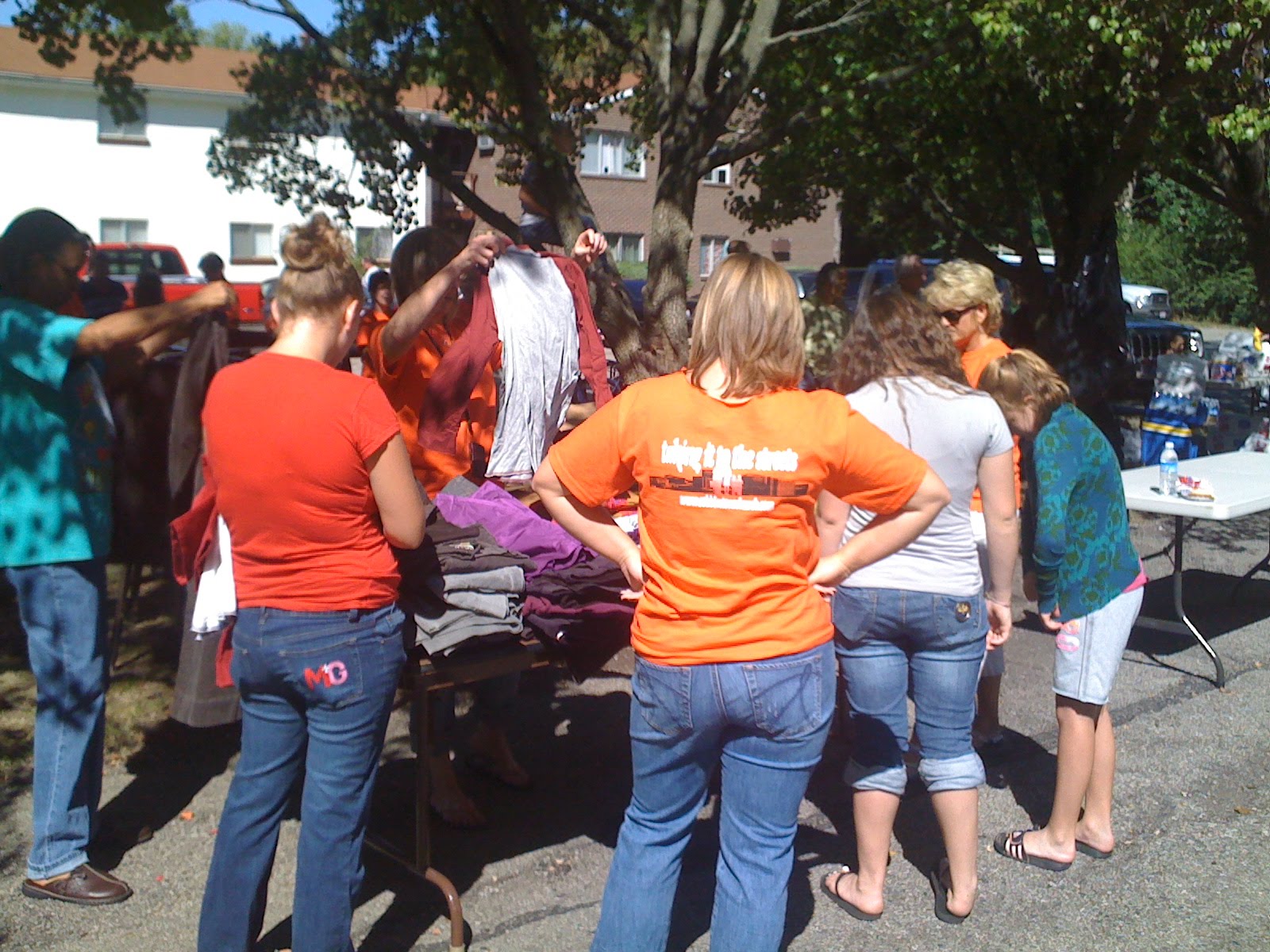
 ....along with car washes in Brookville and McGonigle, and door-to-door giveaways and a block party at Parkview Arms Apartments, where we gave away a donation of brand-new clothes we'd been given....
 ...and climbed trees....
 and played with kids and hula hoops....
 ...and fixed and served free food....
 ...and also at the Oxford mobile home park, where we did a door-to-door goody-bag giveaway (this is just one of many teams)....
 ...and several teams performed cleanup tasks around the mobile home park....
 ...AND a cookout with games and free food...
 ....AND then there were two outreaches in which Cobblestone volunteers made loving visits to the residents of the Knolls and Liberty Nursing Home in Oxford....
 And then, to top it all off, a Con Brio/Under Cover hybrid worship band (Con Cover? Under Brio?) and Andrew BROUGHT IT in The Third tonight, our first "Third" with professional bus service for students to and from Shriver Center!
 Oh, how I praise God for a church that is "taking it to the streets," as our orange outreach shirts say. Thank you to all my brothers and sisters who made this such a beautiful weekend; YOU were the sermon this weekend! And thanks, God, for the beautiful September weather you provided (and the refreshing Saturday morning rain!).
How (And How Not) To Use Facebook for Ministry
 People tease me about my active (some would say overactive) use of Facebook. Some aren't teasing.
I have posted on this blog about how Facebook makes me a better pastor (see here). So Tim Challies's blog post (here's his blog) entitled, "How (And How Not) To Use Facebook for Ministry" was a good read.
Facebook. In so many areas of life it’s no longer an if, no longer an option. With 500 million users it is quickly becoming a near-essential tool for families, for businesses and yes, even for churches.
The good news is that Facebook has a lot to commend it; there many things it does very well and thus there are many ways in which Facebook can assist pastors and other ministry leaders. The bad news is that there are also (and inevitably) ways in which it can hinder ministry if not used well. Today I want to look at Facebook as a ministry tool and suggest a few ways in which it can help and hinder. Because of practical limitations I cannot tell you how to go about setting up an account, but at least I can give some suggestions on what to do once you’ve already joined and started to be active.
One of Facebook’s great benefits for you, as a ministry leader, is that it lets you be where your people are. If you are like most pastors, you will find that your church members are not only members of Facebook, but that they are active members. This is where people socialize, where they entertain themselves and where (occassionally) they discuss serious issues. This is not to say that you need to be on Facebook in order to effectively minister to your people, but it does give you one more way of interacting with them, and one that can be very effective. Facebook is at its heart a social media, one used to coordinate communication and this is where you will find that it assists ministry. However, there are a few areas in which you will need to be cautious.
Use Facebook to Supplement Real-World Ministry
As you consider using Facebook in your ministry, or as you consider how you are already using it, spend a few minutes thinking about what Facebook has replaced. It is generally true of new technologies that they do not just add something to life, but that they also replace something that is already there. In the case of Facebook, it may well be that it is replacing real-world face to face ministry. Facebook builds social connections and in some ways enhances them; but it can just as easily diminish them as it replaces offline life with online. There is always the temptation to take the easy route (Post “Happy Birthday” on someone’s wall instead of calling him; Send an email instead of meeting him for lunch). Be sure that you are not allowing Facebook to be an easy way of getting around difficult ministry. And make sure you are not using it to disincarnate yourself, to remove your physical presence from people’s lives.
So as you use Facebook, be careful to use it in a supplementary way, a way that supplements your real flesh and blood contact with the people you are seeking to serve. Use it to share event information, to get people remembering last week’s sermons and thinking toward next week’s, to get people singing the songs you sing and praying for what needs to be prayed for. Use it to share photographs of great events and to encourage people to make contact with one another. The ways it can supplement ministry are nearly endless. But all the while use it to push yourself toward, not away from, face to face contact.
Learn, But Don’t Be a Stalker
There are parts of the shepherding ministry that are active and parts that are passive. This is to say that in many cases you will inadvertently encounter information relevant to your ministry—things you need to act on. You may be told by a mutual contact that there is an important date coming up in another person’s life or that someone has committed a grevious sin. You did not go looking for the information; rather, it came to you. There are other times that you will be more proactive in seeking out information. You may approach a person and ask how he has been doing recovering from a surgery or you may ask him how he has done in the battle against a particular sin.
Facebook can help with both of those components of ministry, with both the active and the passive. But you will need to guard against the temptation to be constantly trolling for information (negative information in particular), to go looking at vacation photographs to see if something is amiss (“She shouldn’t be wearing that on the beach!”), to read walls to find errant messages and responses (“Whoa! That sounded a bit snarky!”). There are times you can use the information you encounter in a way that will bless and encourage and there are times you can use that information in a way that will seem downright creepy. The societal rules about what we may do with information we encounter on Facebook are still being written; until they are, be careful. It may be that you will offend people even as you seek to help them.
Use it to learn about the lives of the people you love, to encourage them, and just generally to be aware of what they are doing in life. But do not use it to stalk them; and be careful how you introduce information you’ve learned from Facebook into real-world conversation.
Be Aware
Be aware that much of what happens on Facebook is public and be aware that what is public and what is private seems to be in constant flux as Facebook matures. Posting “Had a great time last night!” on a friend’s wall may just be a little confusing (especially if that friend is a woman). Also, be careful as well that you do not assume too much from information you encounter about others on Facebook. Because much of what you will encounter will be torn from context, you will need to use that information very carefully. Believe the best whenever it makes sense to do so.
As much as Facebook can grow community within the church, it can also hinder it. When you post photos of an event that only ten or twelve families were invited to, understand that all of the families in the church will see them and all those who were not there will wonder why they were not invited. Be aware of those aspects of Facebook that will alienate people and convince them that they are outsiders. I’ve said it before: I didn’t know how much fun my friends have without me (and how often they have it!) until Facebook came along!
Be Present but not Always Present
Though Facebook can be a valuable tool for the pastor, it is a tool that is far more often used to waste time than to redeem time. Your congregation will be glad to see that you have a presence on Facebook, but they will be dismayed if they see that you have a constant presence. if they see that you are continually commenting, chatting, posting notes, interacting and racking up high scores on Bejeweled Blitz, they will come to believe that you are spending your entire day there. Even if that is not the case, you will want to be very cautious to give them no reason to think that you are wasting your study time or sermon preparation time stalking them on Facebook. So use it, but use it carefully and sparingly.
Don’t Play Farmville
Just don’t. It’s stupid and it will make you stupid.
Subscribe to:
Posts (Atom)